
// For fintech leadersYour AI investment impresses the board.
So why isn't it processing anything?
Fintech leaders are spending more than ever on AI and automation tooling — but when pilots can't connect to payment rails, compliance systems, or ledger entries, the ROI stays theoretical.
This is what “pilot purgatory” looks like in fintech — and it's more fixable than it seems.
The problem usually isn't the model. The demo works. The accuracy metrics look strong. But somewhere between "this is promising" and "this is running in production," the initiative stalls — because the AI can read your data, but it can't act on it.
In fintech, that gap is unusually costly. Your payment infrastructure, compliance logic, KYC and AML systems, ledger architecture, and risk tooling were built at different times, by different teams, under different regulatory assumptions. Almost none of them were designed to expose real-time event triggers to a layer above. So your AI ends up analysing snapshots — not operating inside systems.
The compliance team flags the handoff risk. The build team moves to the next initiative. The pilot sits in review. Your board starts asking questions about AI ROI that nobody has a clean answer to.
Whale Song works with fintech technology leaders to close that gap. Not by replacing your infrastructure — by making the software you've already committed to actually function inside your operational and regulatory constraints.
95% of AI pilots
fail to deliver ROI
Source: MIT Project NANDA, The GenAI Divide
That number isn't unique to fintech — but fintech feels it in a specific way. The sector has invested heavily in AI-powered fraud detection, compliance automation, and intelligent payments infrastructure. Most of it is still waiting to move from "interesting pilot" to "changed how we process." The gap is almost never the model. It's the architecture beneath it.
Fintech investment has accelerated faster than the operational infrastructure beneath it. The result is a pattern most senior technology leaders in the sector recognize immediately — even if they haven't fully named it yet.
// The integration gapMost fintech stacks are a collection of systems that predate the expectation of real-time interoperability. Core banking platforms, payment processors, compliance engines, ledger systems, and fraud tooling each hold a critical piece of the operational picture — and almost none of them were designed to accept instructions from an AI layer above without a human authorisation step in the middle.
So when you deploy an AI model, a fraud detection system, or an automation layer, it sits on top of that architecture reading what it can access — but unable to trigger a payment action, update a compliance state, route an exception, or write to a ledger without staff intervention. The model is accurate. Your team is still doing the work the model was supposed to do.
How many of your current systems can act on a payment or compliance event without a human in the loop?
Your AI can see the payment data.
It just can't touch it — and that's the whole problem.
// The roadmap gapThe build team shipped it. The compliance team inherited it. Nobody owns what happens next.
Fintech software initiatives have a structural handoff problem that most organisations don't name until it's too late. The team that builds the AI layer is rarely the team that manages AML reporting, handles dispute resolution, or runs the reconciliation desk. When the pilot transitions to operations, those teams receive a tool — not a system they helped design for their actual workflows.
Adoption fails quietly. The operations team develops workarounds. The build team is already three sprints into the next initiative. Six months after go-live, the AI pilot is technically live and functionally ignored — generating outputs that nobody has a clear process for acting on.
The build delivered. The workflow didn't change.
When your last major fintech software initiative went live, who was accountable for adoption six months later?
// The ownership gapYour roadmap has features. It doesn't have a path through your compliance constraints.
Most fintech technology roadmaps are built around product milestones — what the software will do when it's finished. They are rarely built around the integration dependencies, data governance requirements, and regulatory clearances that determine whether the software can operate at all. In fintech, those dependencies are not peripheral to delivery. They are the delivery.
The result: build teams hit the end of a sprint and discover that the compliance layer hasn't been mapped, the data isn't structured for real-time access, or that a regulatory requirement adds three months of work that wasn't scoped. The roadmap wasn't wrong. It was just optimistic about a set of problems it never named.
Does your current roadmap show when compliance and integration work happens — or does it assume those are someone else's problem?
If any of those questions produced a quiet recognition rather than a confident answer, you're in the right place.
// Direct from our fintech workWe've seen exactly what stops fintech AI from reaching production.
We've also fixed it.
VerityPay came to Whale Song with a problem that looks familiar to most senior fintech leaders. Their AI layer was built and technically functional — but it couldn't operate inside their actual systems.
Historical payment data was locked in legacy SQL. Jurisdictional compliance rules were embedded in business logic rather than exposed as structured, queryable states. Exception handling ran through email. There were no real-time event triggers. The AI was analysing snapshots — not operating inside systems.
Whale Song:
surfaced and unified the dark data silos
exposed a modern API layer covering payment status, compliance states, jurisdiction logic, and event triggers
normalised historical data
structured governance rules as executable logic, and
established real-time data flows
The outcome: AI that could trigger payment actions, auto-route exceptions, predict compliance risk, and operate within governed constraints — without a human in the middle of every transaction.
That is what production-ready fintech AI actually looks like. And that is the gap Whale Song is built to close.

“Whale Song operated like a true partner for VerityPay — proactive, collaborative, and consistently responsive. They translated complex needs into clear execution, stayed on track with timeline and budget, and remained engaged even when we involved our own customers in the process.”
Robert Bowden // President & CEO, VerityPay
16x lower risk
of fraud, theft, & loss
90% reduction
in cost per payment
“AI doesn’t create leverage until it can move money, data, or workflow states
without human middleware”
~Jason Amunwa, Product Strategist @ Whale Song
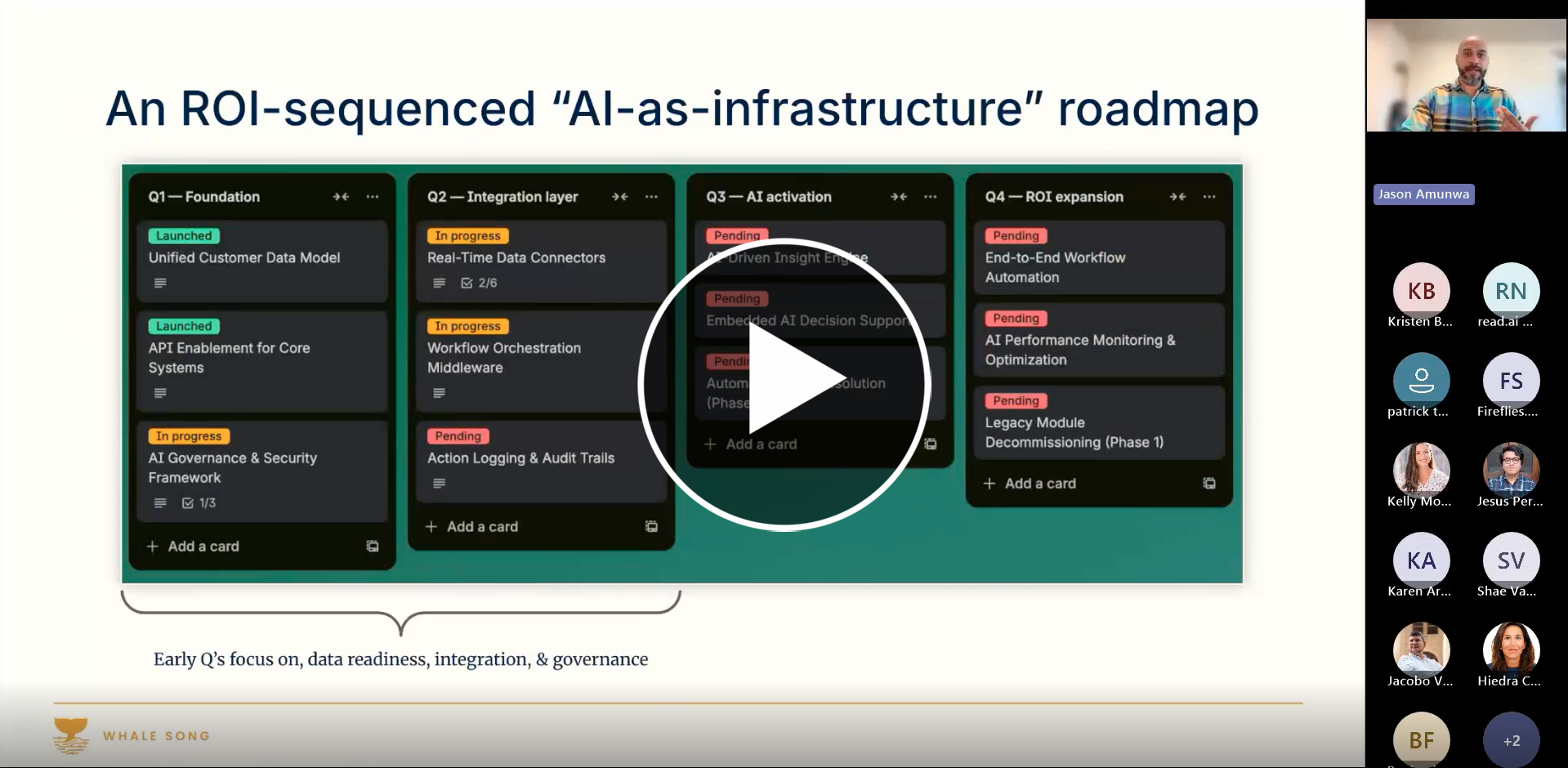
// On-demandWatch the full session:
Escaping Pilot Purgatory
In this 45-minute session, Whale Song's product strategists break down why AI initiatives frequently stall after the pilot — and what an execution-ready roadmap actually looks like.
Covers the four root causes, the common warning signs leaders miss, and real case studies from our successful production deployments.
// For fintech leadersBook a 1:1 strategy session with Whale Song's product team. We'll conduct a RAID — a structured review designed specifically for fintech leaders who are managing software investment that isn't yet delivering operational ROI.
R — Review your current technology initiatives, pilots, and integration dependencies
A — Assess your roadmap for the risk signals that predict stalled delivery
I — Identify your integration and data readiness gaps — the ones blocking production ROI
D — Define your next 90-day execution focus, with clear ownership and sequencing
One session. No sales pitch. A structured conversation with people who have built compliant financial technology solutions at scale.
Stuck in pilot purgatory?
Let’s plan your escape.
// Go deeperPerspectives on the technology challenges facing fintech leaders
and how to address them
95% of AI pilots fail to deliver ROI — MIT Project NANDA
The GenAI Divide report from MIT's Project NANDA examined why the majority of enterprise AI initiatives stall before reaching operational impact. The findings apply directly to hospitality, where AI investment has accelerated faster than the integration infrastructure beneath it.