
// For hospitality technology leadersYour AI investment works in the demo.
So why isn't it changing anything?
Hospitality tech leaders are spending more than ever on software — but when AI pilots don't reach production or embed in operations, the ROI never arrives.
This is what “pilot purgatory” looks like in hospitality — and it's more fixable than it seems.
The problem usually isn't the software. The demos work. The pilot metrics look promising. But somewhere between "this is working" and "this is changing how we operate," the initiative stalls — handed from the innovation team to operations, with no clear owner and no integration into the systems that actually run the property.
In hospitality, that gap is unusually wide. Your PMS, POS, CRM, and revenue management tools were rarely built to talk to each other — let alone to act on AI-generated decisions.
So your technology accumulates, your team adds workarounds, and your board starts asking questions about ROI that nobody has a clean answer to.
Whale Song works with hospitality technology leaders to close that gap. Not by adding more software — by making the software you've already committed to actually work inside your operations.
95% of AI pilots
fail to deliver ROI
Source: MIT Project NANDA, The GenAI Divide
That number isn't unique to hospitality — but hospitality feels it acutely. The sector has invested heavily in AI-powered guest experience, revenue management, and operational tooling. Most of it is still waiting to move from "interesting pilot" to "changed how we operate."
Hospitality technology investment has accelerated faster than the operational infrastructure beneath it. The result is a pattern most senior technology leaders in the sector recognize immediately — even if they haven't fully named it yet.
// The integration gapMost hotel technology stacks are a collection of point solutions that predate the expectation of interoperability. PMS, POS, CRM, revenue management — each holds a critical piece of the guest picture, almost none of them were designed to share data in real time, and almost none of them allow a new tool to act on that data without a human in the middle.
So when you deploy an AI layer, a dynamic pricing system, or a guest messaging platform, it sits on top of that fragmented foundation — reading some data, some of the time, but unable to trigger a refund, update a record, or escalate an exception without staff intervention. The tool works. Your team is still doing the work.
How many of your current tools can act on guest data without a human in the loop?
Your tools work. They just don't work together → and your AI is paying the price.
// The roadmap gapThe team that buys the software is
rarely the team that has to live with it.
Technology initiatives in hospitality typically start with someone who has budget authority but not operational reach. The people who will actually determine whether the software succeeds — front desk managers, revenue ops, F&B supervisors — often see it for the first time at go-live.
From there, staff find workarounds, edge cases get handled manually, and within eighteen months the initiative exists on a dashboard somewhere but has stopped changing how the property operates.
The build delivered. The adoption didn't.
When your last major software initiative went live, who was accountable for adoption six months later?
// The ownership gapYour roadmap is a feature list. It should be a sequenced path to operational ROI.
The most common finding when Whale Song reviews a hospitality technology roadmap: it was built around vendor capabilities and internal wishlist items, not the specific operational workflows that need to change for the investment to pay off. Integration dependencies are deferred. Data readiness work doesn't appear at all. Success is measured by whether the tool works in a controlled environment — not whether it's changed anything in production.
This is pilot purgatory. And it isn't unique to AI — it applies to any software initiative where the build and the operationalization are treated as two separate projects, with the second one never quite getting its budget approved.
Does your current roadmap show when integration work happens — or does it assume integration is someone else's problem?
These aren't technology failures
They're execution failures — and they're fixable with the right sequencing, the right ownership structure, and a product partner who treats integration as the work, not the afterthought.
// Hospitality expertise, from the ground upOur founders built iHotelier,
one of hospitality’s most used software platforms.
Before Whale Song, the founding team built iHotelier — a cloud-based Central Reservation System that grew to serve more than 25,000 hotel customers across 176 countries.
TravelClick acquired iHotelier as the core asset of their platform. Amadeus later acquired TravelClick for $1.52 billion. iHotelier still runs as a flagship product within Amadeus Hospitality today.
That project started with the same problem this page describes: hotels managing reservations across disconnected channels, with legacy systems that couldn't keep pace, producing pricing inconsistency, distribution inefficiency, and missed revenue at the first point of guest contact. The solution wasn't a better feature. It was a unified architecture built around how hotel operations actually work.
That's the experience Whale Song brings to every hospitality engagement.

“AI doesn’t create leverage until it can move money, data, or workflow states
without human middleware”
~Jason Amunwa, Product Strategist @ Whale Song
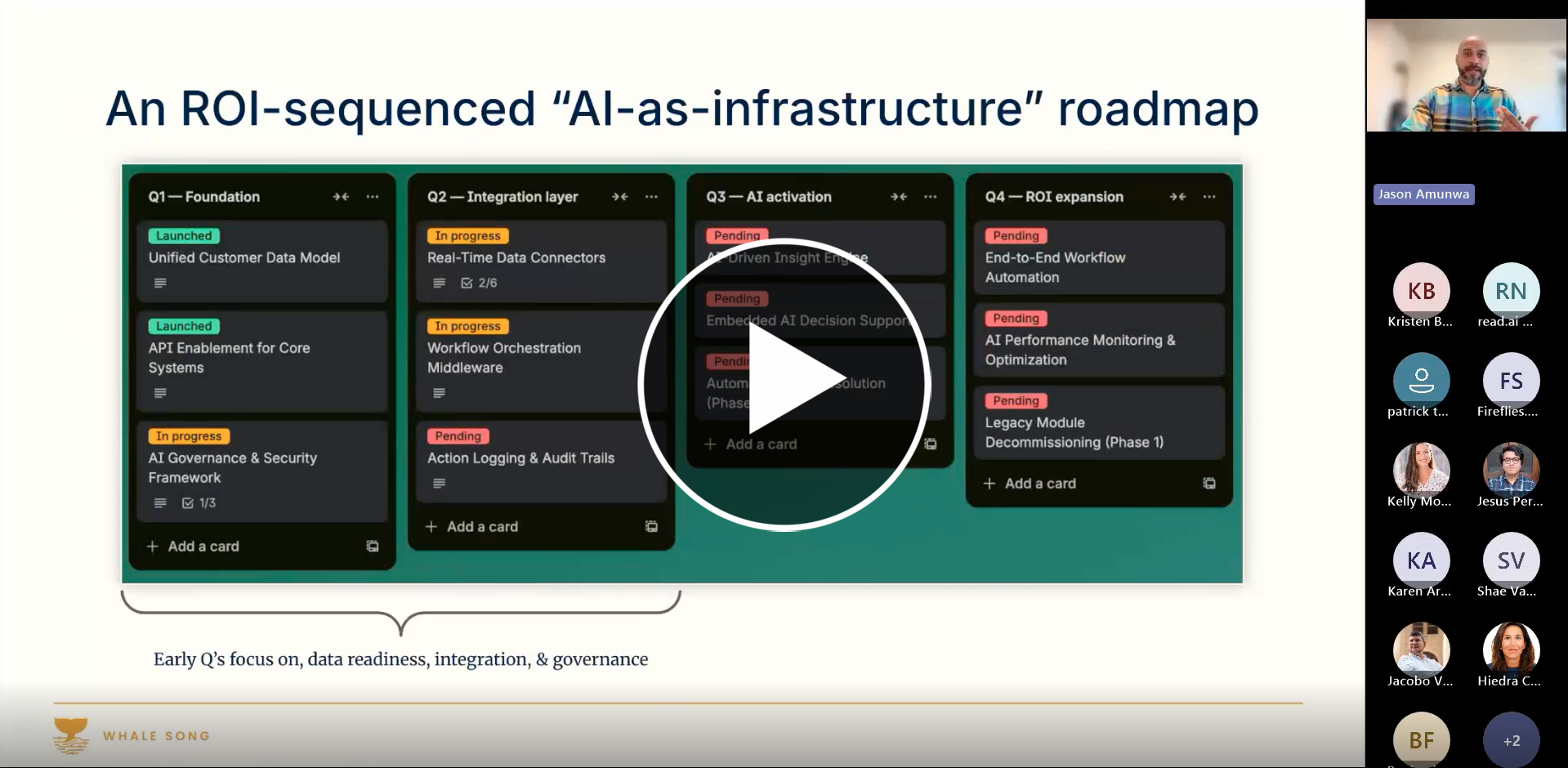
// On-demandWatch the full session:
Escaping Pilot Purgatory
In this 45-minute session, Whale Song's product strategists break down why AI initiatives frequently stall after the pilot — and what an execution-ready roadmap actually looks like.
Covers the four root causes, the common warning signs leaders miss, and real case studies from our successful production deployments.
// For hospitality leadersBook a 1:1 strategy session with Whale Song's product team. We'll conduct a RAID — a structured review designed specifically for hospitality leaders who are managing software investment that isn't yet delivering operational ROI.
R — Review your current technology initiatives, pilots, and integration dependencies
A — Assess your roadmap for the risk signals that predict stalled delivery
I — Identify your integration and data readiness gaps — the ones blocking production ROI
D — Define your next 90-day execution focus, with clear ownership and sequencing
One session. No sales pitch. A structured conversation with people who have built hotel technology solutions at scale.
Stuck in pilot purgatory?
Let’s plan your escape.
Frequently asked questions
-
Most hotel software implementations fail not because the technology doesn't work, but because the build and the operationalisation are treated as two separate projects — with the second one never fully resourced or owned. The tool gets deployed into a stack it wasn't properly integrated with, adopted by teams who weren't involved in specifying it, and measured against metrics that stop at go-live rather than operational impact. The result is software that functions in isolation but doesn't change how the property runs.
-
Pilot purgatory is when a hotel technology initiative works in a controlled environment — the demo looks promising, the pilot metrics are positive — but fails to scale into real workflows, measurable outcomes, or governed production systems. It's the gap between "this is working" and "this has changed how we operate." In hospitality, it's particularly common because the underlying stack — PMS, POS, CRM, revenue management — was rarely built for interoperability, which means new tools can read data but can't act on it without human intervention.
-
An ROI-sequenced hospitality technology roadmap works backwards from the specific operational workflows that need to change, not forwards from a feature list. It treats integration dependencies and data readiness as first-class work items — not future phases — and defines clear production ownership before the build begins, not after go-live. Success criteria should be tied to operational outcomes: whether a workflow changed, whether a system can act without human middleware, whether the investment has moved the metrics it was purchased to move.
-
The majority of AI pilots in hospitality stall because AI is treated as a feature to be added rather than infrastructure to be integrated. A pilot can demonstrate that a model produces useful outputs — recommendations, predictions, classifications — without any of that being connected to the systems where those outputs need to trigger real actions. If AI can't act inside your PMS, your POS, or your revenue management workflow without a staff member manually transferring the output, it isn't delivering ROI. It's delivering insights that humans are still executing on.
-
The most important thing a hospitality technology partner can demonstrate is that they understand the operational context their software has to live inside — not just the technical requirements. That means asking about integration planning before design begins, defining production ownership as part of the project structure, and sequencing the roadmap around the workflows that need to change rather than the features that are easiest to build. Prior experience building hospitality-specific systems at scale is a meaningful signal — it's the difference between a partner who will need to learn your environment and one who already knows where the bodies are buried.
// Go deeperPerspectives on the technology challenges facing hospitality leaders
and how to address them
95% of AI pilots fail to deliver ROI — MIT Project NANDA
The GenAI Divide report from MIT's Project NANDA examined why the majority of enterprise AI initiatives stall before reaching operational impact. The findings apply directly to hospitality, where AI investment has accelerated faster than the integration infrastructure beneath it.